Total Pageviews

Tuesday, December 15, 2020

Chair 2020/2021

 To begin with Thank You Trustee Geddes. Lynette, thank you for your leadership this past year as Chair of AMDSB. It was a year you probably won't forget but maybe you don’t want to. You endured.


What can I offer? Leadership. Readiness, organized, governance, inquisitive, receptive, collaborative, openness, adaptive, reflective. I said can, I wonder if it should be may? I am still waiting for them all to come together. We are understanding more of the importance of the critical/transferable skills within education and the workforce and continue to incorporate them into the learning relm.


I ask myself where is my voice better used, around the table or at the head of the table? 


What do I envision? A Board of Trustees unified in the vision and the goals of “I am Prepared. I am Well. I am Engaged.” Unified does not mean controlled or voiceless but empowered. I ask myself where your voice is? The voices around this table are important. I, as Chair need to be able to comprehend and understand what those voices are saying  “I am Prepared. I am Well. I am Engaged” does not just apply to our students and staff but also to parents/guardians and the broader community. The saying goes ‘it takes a village to raise a child.’


As we launch our new 2020-2024 Strategic Plan it is important that we see and feel and ultimately live what those words convey to achieve Student Success and Well-Being. This past year has been a challenge as we maneuvered through the Pandemic, now we need to take what we have learned to continue to provide a safe and caring environment for our students and staff. Some of the ideas from Share Your Voice are very applicable here. The Equity needs of BIPOC, social economic disadvantaged and Spec Ed Students will continue to require attention. The Mental Health needs of all within AMDSB will necessitate action. I am looking forward to where the Pathways Advisory Committee will take us. The road ahead of us appears long and challenging, we will travel it and see the rewards within our students and staff. I will stop here but We will continue.


Learning, education and knowledge give you both roots and wings. The broader the knowledge the deeper the roots and stronger the foundation. Being a lifelong learner allows those wings to soar beyond what we may have envisioned for ourselves. But most importantly for the students and staff we serve.


As we revise from Engaged. Inspired, Innovate, let's travel the journey together. Much has been done and more needs to and will be done. Yes, I am Always Learning. Learn with me.


Monday, May 20, 2019

When The Dust Settles?

For those of us in the Ontario Education System whether it be students, parents, teachers, staff, administration, trustees, consultants or whatever capacity, our heads have been in a continual spin this last little while. Be it in trying to understand the rationale behind the current changes and/or the consequences of them, we are being put to the test.

These next few statements maybe unpopular but are being stated to make you think. Do I believe in them by the end of this post that will be your determination? Has Education be too easy funded this past decade? Has there been direction and purpose in past Education Policy decisions?

Here is the funding memo for 2012, GSN 2012 Funding $21B. From this memo "Between December 2003 and the 2011-12 school year, the government has increased funding through the GSN by $6.5B, or 45 percent, while also making significant investments outside the GSN in school capital and FDK." (FDK became fully implemented and the funding moved to the GSNs in 2014.) This is the Technical Paper released with the 2014 GSNs GSN 2014 Funding of $22.53B Here is 2018's memo 2018 GSN Funding of $23.9B. Per pupil funding of $12,300.This is the Memo for the 2019 GSN GSN 2019  Funding of  $24.66B Per student funding of $12,246. We are still waiting for the 2019 Technical papers.

Can one compare beyond the total numbers the increases in Education Funding from year to year? With great difficulty, yes. Don't forget about the special funding, formerly known as Education Programming Other and now referred to as Priorities and Partnership Funds. They come and go from year to year so they can never be counted on. Capital Funding always comes into play. Don't forget Early Years and Childcare now fall under the Ministry of Education.

Here is the link to the April 2019 Budget. In March the Ministry released their New Vision for Education entitled Education That Works For You. Within it, Modernizing Classrooms, Modernizing Learning and Modernizing Health and Physical Education. Again the 2019 GSN and the accompanying Priorities and Partnership Funds. Now the 2019 Board Estimates. A lot of information to go through and analyze to determine things. Yet we still wait for the Technical Papers that break down how much, where, and how (requirements &/or restriction) these Funds can be used. The Grants fall under certain areas: Pupil Foundation, School Foundation, Special Education, Language, Indigenous Education, Geographic Circumstance, Learning Opportunities, Safe & Accepting Schools, Continuing Education, Teacher Qualification, Student Transportation, Declining Enrolment, School Board Administration & Governance, School Operations, School Renewal,  Interest.

On top of this the Government's Consultation of Classroom Size if not over until May 31st. Will things change again?

I think you are probably tired of number crunching.

But it is this $ numbers that determine what Education looks like, be it priorities, initiatives, staffing, course offerings, etc, etc. Go back to Education That Works For You. There has been a refocus on certain areas; math & literacy, and emphasis on others; SHSM & trades, and some new; e-learning. Secondary schools face the biggest challenge with the purposed changes in classroom size funding and the staff reductions and consequential loss of courses and student supports. This is what it looks like in the TDSB. Waiting on what it will look like within the AMDSB. We do know we are seeing a budget reduction of $2.6m +/-. Elementary and Secondary Teachers have received layoff notices. Here is the Guide to 2018/2019 GSN related to the finding areas mentioned previously. As you can see funding is allotted to certain areas with certain requirements, therefore, moving money around is not that simple. An example is classroom size funding, the recently announced change of funding from 22:1 to 28:1 has a direct connection to teacher staffing levels. To compensate for that loss where can the money be found to move around without making cuts in other areas? Many boards already struggle to cover overspending in Transportation and Special Education. One always has to remember there are differences between effectiveness and efficiencies within each of these areas.

For some reason, I keep coming back to the Liberal's Drummond Report 2012 and Hudak's 2013 Path to Prosperity to get a glimpse of what still may be coming.

The dust hasn't settled yet but I will say it will not be pretty when or if it does.

PS: I apologize for all the links.

Saturday, April 20, 2019

A Brief History of Ontario Education

The Education sector in Ontario, to be honest ever sector in Ontario, is going under radical change these days. To me, these changes are not for the better. I cannot see the rationale behind these changes because none has been given and no actual plan or vision has been put forward.
To move forward it is helpful to know where you came from. My formal involvement in Education began in 2010 being elected a Trustee in the AMDSB. Informally it began in 2005 when my youngest began school followed by involvement in ARCs, SAC and PIC. So let us look back at Education but not too far back.
I lied. “In 1907, the Canadian Manufacturers’ Association declared, “The competition of the world has become so strong that we cannot afford to fall behind in the race for efficiency. . . . Technical education must come . . . we must educate our people towards efficiency” (p. 844)”. (Global Change and Educational Reform in Ontario and Canada, Brian O’Sullivan)
Much reform/change to Education is Ontario took place under the Government of Premier Jason Robarts and Minister of Education William Davis (future Premier) in the 1960s.
The Hall-Dennis Report: Living and Learning: The Report of the Provincial Committee on Aims and Objectives of Education in the Schools of Ontario of 1968. ‘We stand today in the dawn of our second century and assess the field of future education . . . we must not lose sight of the human needs that the new dawn brings . . . we have in our hands the means of change for human betterment . . . for the people of Ontario . . . for all Canadians, and hopefully... [for] all mankind. (p. 9)’ I can find lots of references to the Report but not a good link. The Hall Dennis Report: Living and Learning
I will pick up here in 1993/95.
The Ontario Royal Commission on Learning was initiated by the NDP Government of Premier Bob Rae. This Government was replaced by the PC Government of Premier Mike Harris in June 1995. Royal Commission on Learning: For the Love of Learning
“In May 1993, the Province of Ontario established the Royal Commission on Learning "to ensure that Ontario's youth are well-prepared for the challenges of the twenty-first century."
After exhaustive public consultation, the Commission released its report, entitled For the Love of Learning, in January 1995. The report was to suggest a vision and action plan to guide the reform of elementary and secondary education. This would include values, goals and programs of schools, as well as systems of accountability and educational governance.” (Ministry of Education Ontario website)
In its Introduction the Committee made the following:

“A climate of uncertainty

-Like all organizations, our Commission operated within a particular time, and our deliberations were inevitably influenced by the context of unsettling truths around us.
-Our society is characterized by turbulence, creating widespread uncertainty and anxiety. Canadians fear a future of diminished opportunity, and expect public institutions to deal with this acute concern.
-Our economic system is changing, while technology is advancing at a geometrically accelerating pace.
-The fallout from those related phenomena includes the prospect of a large core of permanently unemployed and underemployed men and women, of younger people in particular, and of considerable confusion about the future of work.
-In the current political climate, and for the foreseeable future, projects requiring vast new public funding will be seen as impractical. The operative cliche is that it is possible to work smarter, doing even more with even less.
-The composition of Canada's population is changing dramatically, not least in Ontario and, above all, in southern Ontario. Each year, we become an increasingly diverse nation, but our institutions often fail to reflect that diversity.
-There is a sense that traditional social institutions have been breaking down, and that the family, as well as community and religious organizations, are no longer able to instil personal and ethical values in successive generations of Canadians.
-Despite uncertainty about common values, large segments of the population are not content to live in a society that has no identifiable values.
-At the same time, and for a variety of reasons, Canadians have been losing faith in their public institutions. As a result, they have been demanding that these operate more openly, involve more citizen participation, and become more explicitly accountable to the public at large.
-Schools necessarily reflect - at least to some extent - the societies in which they operate. Therefore, it is not surprising that today's education system feels shaky, unsure, lacking in self-confidence, and struggling with a mandate that is increasingly uncertain and whose purposes are no longer self-evident. Not only is that the background against which the Commission operated, it was the reason the Commission was established.”
In its Conclusions and Implementation were:
“In the course of our own extensive work - and learning - certain lessons about the process of education reform became clear. If we fail to take these lessons to heart, we fear that the process of change may well be doomed from the outset.
  1. There are no instant solutions to the problems of today's schools, no short cuts. But there are solutions.
  2. The process of learning is highly complex, but there are ways to get our children to learn better.
  3. The education system is enormously complicated, but there are ways to transform it.
  4. No serious change can happen without the willing co-operation of teachers.
  5. Parents who create an atmosphere that values learning, and who support their children's school efforts, are giving their children a major advantage. Parents are a largely untapped resource.
  6. The best way to ensure that kids do well at school is to provide all of them with affluent, literate, professional parents. Clearly, this is impossible; however, schools can compensate for the disadvantages many students bring with them from home. So even though a student's background remains the chief determinant of educational success in Ontario, schools have the capacity - if they have the will to overcome the handicaps of a child's background.
  7. When all is said and done, we place our confidence in the knowledge and dedication of the professional educators of Ontario. While every parent and every member of the community has significant contributions to make, it is our teachers, principals, and other educators who must provide the inspirational, active, hands-on leadership role that is needed.
  8. There are important and powerful players in the education system. The influence of some of these players, like the teachers' federations, is obvious, while that of others, equally powerful, for instance, universities, is less well known. But all players must be committed to the process of radical change if it has any hope of success.” (Ministry of Education Ontario Website)
Do any of these still apply today?

Noted above the PC government of Premier Mike Harris was elected in June 1995 before anything from the Commission could be implemented. The PC government was elected on the ‘Common Sense Revolution’ platform with ‘New Direction II: A Blueprint for Learning’ as there education vision. You can research yourself if you don't recall, the changes to the Education system under the PC government. The PCs remained in power until 2002 when the Liberal government of ‘Education Premier’ Dalton McGuinty was elected. I will leave it to your own curiosity to discover the impact of the Liberal Government under McGuinty and Wynne until 2018. ‘Ontario a Leader in Learning (2005) looked at post-secondary education. K-12 reform continued with  ’Energizing Ontario Education (2008). The Fullan Report (2013) ‘Great to Excellence’ laid the groundwork for the Liberal vision ‘Achieving Excellence’ (2014) Many of these reports have been removed from the Ministry's website.

I will note the Drummond Report 2012 that was commissioned by the Liberal Government. The Drummond report examined every aspect of Government in Ontario. The Drummond Report: Commission on the Reform of Ontario's Public Services In Education, it made 27 Recommendations. I will highlight three of them here:
“The Drummond Report 2012
Recommendation 6-3: The elementary and secondary education sector should stay the course with its current agenda, which consists of three key goals: improving student achievement, closing gaps in student outcomes and increasing confidence in the publicly funded school system. The province and the sector must sustain the current alignment between provincial, school board and school-level efforts, and sustain the “pressure and support” approach adopted in recent years.
Recommendation 6-4: Reforms in the elementary and secondary sector should be introduced so that all stakeholders have their role to play in ensuring the system’s long-term sustainability and so that unnecessary sources of distraction are avoided.
Recommendation 6-5: To ensure transparency and effectiveness, the province should confirm multi-year allocations to school boards for the 2012–13 to 2017–18 period so that they can plan accordingly, have enough time to find the required efficiencies and enter negotiations for renewal of the sector’s collective agreements that will expire on Aug. 31, 2012, with clear knowledge of their budgetary position.” (Ministry of Finance Ontario Website)

I think someone needs to read these!

As I wrote this I came upon this report: Policy Trends in Ontario Education 1990-2003, Anderson & Jaafar (2003). Policy Trends in Ontario Education 1990-2003 Would like to see if there is an updated version.
In 2018 the Liberals were replaced by the election of the PCs under Premier Doug Ford and their ‘Plan for the People’ Platform. If you don’t know what is going on in the Education Sector within the vision of ‘Education that Works for You’ these days you must be living under a rock.

Did this post ever grow beyond what I had envisioned but yet there is much missing. You can see there are policy trends between parties. Only partial implementation of others or even worst the wrong implementation of recommendations. Putting your own spin on things.
A problem with Education is Ontario, it is always at the whim of the government in power. Therefore it will always be at times stagnant, going forward and unfortunately backwards.

Thursday, February 28, 2019

The Want To Learn


This is somewhat a two perspective reflection.
I am maybe my hardest critic. This quote always resonates in my head. “one rises to their level of incompetence.”
Does that mean one can only obtain so much? Picture a student with the same thought. It goes against everything we try to say and encourage in them, “chase your dream”, “you have the potential”, “you have the ability”. At times I feel as though I have reached my plateau and then someone says “you are doing a good job.” or “Have you considered taking on this?” Most of us strive to do more, reach higher, expand our horizons. As trustees we are charged with student achievement and Well Being within the guise of preserving, advocating for and advancing public education. At times you may feel that you have gotten in over your head or think whoa that person knows their stuff and your self esteem and confidence sinks. Imagine how a student feels when they ‘get it’ versus when they ‘don’t get it’. Why is that person so knowledgeable or how did that person become so informed? Was it just work related knowledge, experience, research or PD? Or is it personal desire to grow to make that plateau higher and higher? How often have you heard  “there is no stupid question?” and then get laughed at for asking that question. How does that make you feel? How do you think it would make a student feel asking that question that everyone pretends to know the answer to? Worth is not measured by intelligence. It is your desire to improve, grow, learn that are key elements of success. Many students have not developed a desire/passion to learn or that passion that drives themself to learn or have lost it or had it destroyed. We are beginning to realize that more often than not that passion for discovery is extinguished by school. Which theory do you want to pick? As adults most of us have realized the benefits of lifelong learning. We must put in place the conditions that encourage our students to be the same. It may only be tiny steps but one has to begin somewhere. It goes beyond extrinsic or intrinsic motivation or applying cognitive principles or metacognition. Who knows what the ripple effect may be.
From our Board Plan: “At AMDSB, our goal is to foster successful graduates. We define successful graduates as students who leave AMDSB prepared for their next steps and understand themselves as learners and advocates for their own needs, are literate and are numerate. They are also prepared for a changing world and are confident and curious thinkers, resilient and flexible thinkers who demonstrate global competencies (communication, critical thinking,  creativity, collaboration and problem solving) and positive and principled engagement in society.”
Engage Inspire Innovate… Always Learning: needs to be more than just words for us as trustees and administration and for our students.

Sunday, December 2, 2018

The Glut of Overwhelming


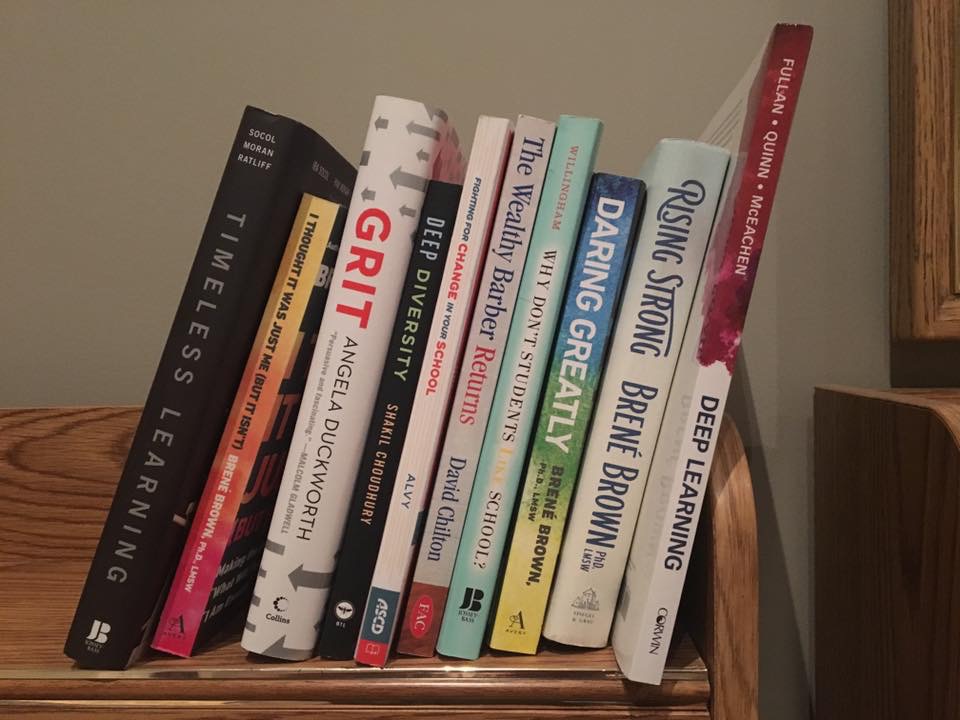
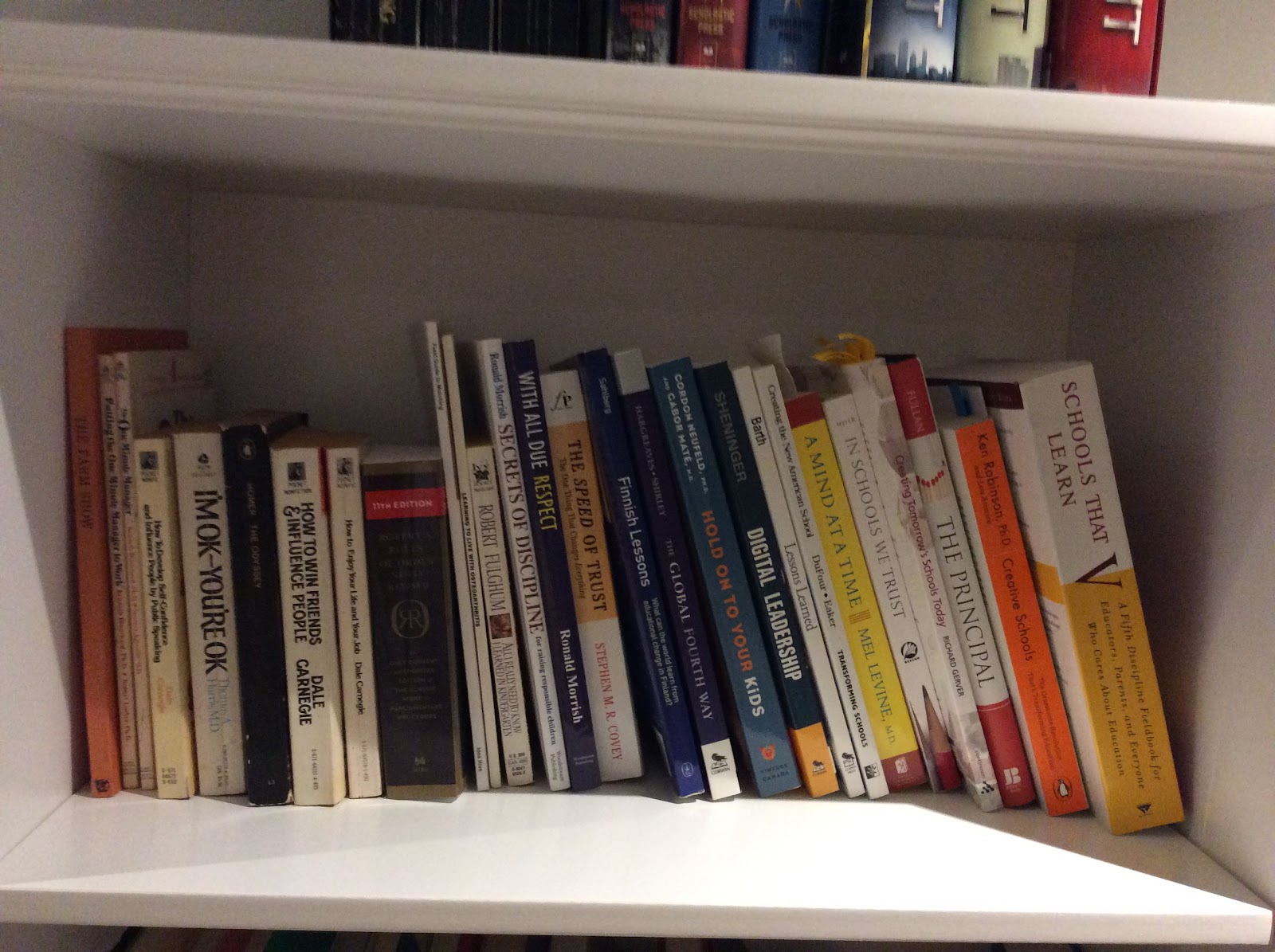
A while ago I posted the picture (l) on Facebook with the comment “‪My bedside
reading library is growing. Need to get to it.” The photo (r) could be added too
with a similar comment, how ever I have read some of these.

The amount of information and therefore knowledge that is out there is over-
whelming. There are many more books I would like to add to my library but if I
can’t get around to reading them what is the purpose. Show? To be honest I
usually fall asleep 15 minutes after sitting down with a book. Much the same
can be said to the number of articles I have bookmarked/tagged  from social
media. These however also fall prey to different problems. Graze or skim reading,
Skim Reading is the New Normal or the butterfly defect. Education is Not a
Question of Belief. This post is guilty of these (probably most of mine are).
These two mentioned articles could be cause for their own posts.

The question I ask myself “If or when I get around to doing all this reading am I
able to comprehend and absorb therefore learn from all that lays before me?”
Or feel “I have forgotten ½ of what I’ve learned.” Some would say if I actually
learned it I won’t have forgotten it. Maybe there is truth to that. There is a line
of conversation these day in Education, “what is education and Learning?” Are
students learning or just memorizing what they are being taught?

The amount of information out there creates another problem for me. I keep
looking for more and then become frustrated with my failure to accomplish
the initial task of reading the information let alone learning. A true benefit of
learning is sharing that knowledge. If nothing else through my posts if I am
unable to share my knowledge, at least I am showing my path of learning.
(Ironic that is the name of my Blog)

Maybe I need to follow some of this advice, How To Stop Wasting Your Life,
and tackle that Glut. As I write this I sit in front of the TV, unfortunately it is on.
As I now publish, it is off.

Sunday, November 18, 2018

Thoughts To The Future

I wish I could connect my laptop to my brain as I lie in bed. As soon as I go to write down my thoughts off they go and seldom return resulting in a less vibrant post then envisioned.


We have been having a lot of conversations within AMDSB & beyond about learning, student voice and what schools should look like. This has been facilitated by Will Richardson. He does disturb but if people are open about their thinking wonderful things can happen. Will Richardson is one of many people I consider part of my PLC on twitter and social media.

Getting back to learning, student voice and what school should look like, we need to define learning, teaching and education. What is the difference? Is our education system teaching the students or are they learning. 10 Principles for Schools of Modern Learning

Are schools and education stagnant? How can that be with everything changing all around? Information is all around us and at our fingertips. Well, education is stuck in the past and any change is frowned upon because that is not the way it was done and we are uncomfortable with change. Most of us only remember what we didn’t like about certain classes but do you now embrace the change that could have changed that experience. This is why education change, reform or whatever you want to call it takes so long, usually 20-30 years, or one or two generations of students. It takes the students who were the beginning of the change to become parents or teachers to champion the change.

Student engagement in their learning continually declines throughout time in schools. Only about 30% of secondary students are engaged in their learning. Why is this? There are too many reasons to list. Ask students what they want that would make them engaged and teachers what they need to make their students engaged and many are the same. So as a system we need to start putting conditions is place to allow these changes. The ideas may come from the roots but the change conditions need to be implemented from the top to allow the roots to grow. This article is an interesting read, Making Lessons Fun Does Not Help Children Learn

Look at the discussion around math skills and knowledge these days. Unfortunate too many people have become polarized in their belief with no adaptation to blended delivery. Is rote learning for memorization for speed of recall? Is problem solving absent of formulation? How does a teachers knowledgeable of math play out against their knowledge of how to teach math? The questions go on and on. This statement came across the day “Early math skills are a strong predictor - even more so than reading skills - of later academic achievement and success in the labour market. ( Anne Stokke)". Valid or not?

What needs to be taught, what should be taught in schools? Maybe we can all agree on subject areas but what within those subjects. Curriculum documents are complicated. What is the purpose of that subject and the strands within it? One frequently sees the questions about where are cursive writing and life skills in the curriculum? How or where does cross/integrated subject teaching come into play?

I could make this post long or have gone deeper into the conversation but I will leave it here for now.

This is not a research paper or thesis,  just my thoughts as I grow. Learning doesn’t end with the answer but the grows with the next question.

Tuesday, July 10, 2018

'IT' Has Begun

The writing of this post is overdue but recent events have persuaded me to write it. 

During the recent Provincial Election Campaign it was stressed that although individual Trustees may have political affiliation, the Ontario Public School Board Association (OPSBA) does not. OPSBA advocates for Public Education no matter what political party is in power or forms the Government. This advocacy may take different directions depending on the Government.  In some cases we will be or are heading in the same direction but by different pathways.

Here are the Political Parties' Educational Platforms for the recent elections. Education Platform & 2018 Provincial Election

Previous Governments have done good and bad things for Education on various fronts. The vague PC platform coming into the Election made some cautious. That cautiousness is becoming reality. Globe & Mail  newspaper article.

Those of us in the Education System can only wait and see what unfolds. Do we need to brace ourselves? Advocacy will continue at the Board and Provincial level.

Tuesday, February 13, 2018

Trustee Reflection 18-02-13

 A common thread in education lingo these day. “In Learning it is not what question you answered today but what question did you ask.” 

The most important thing we as Trustees do, our Strategic Plan. AMDSB’s:

We will
Create Positive, Inclusive Learning Environments
And 
Maximize Outcomes for Students
By
Engaging our students, staff, families, communities and our world 
Inspiring with evidence-informed teaching and learning
Innovating through the creative potential of emerging technologies
Guided by Principles of
Equity, Character & Stewardship

The strategic plan sets the direction. On the surface and on the ground what does that look like for/to us as trustees? 

Do we as trustees reflect upon the plan to see where every decision we make fits into it? “We are doing for the students” is not enough. The alignment of the BIPSAW to the Plan allows us to see the many areas that an administrative decision can impact. Do we reflect back, Review, follow up to see how those decisions are materializing? Are they having the goals/results we anticipated? Then there is the SIPSAW. The grassroots on the ground version of the plan.  And then we can’t forget the Ministry’s plans (documents) Growing Success and Achieving Excellence. Within all these plans are various priorities, themes, visions, initiatives, strategies, goals, indicators, etc, etc.

Here is an excerpt from the book Fighting for Change in Your School by Harvey Alvy. (P. 2)

Tyack and Cuban (1995) define reforms as ‘planned efforts to change schools in order to correct perceived social and educational problems’ (p.4) At the same time, they insist that change ‘is not synonymous with progress. Sometimes preserving good practices in face of challenges is a major achievement, and sometimes teachers have been wise to resist reforms that violated their professional judgement.’ (p.5) Sirotnik (1999) maintains that most reforms are ‘about whatever is politically fashionable, pendulum-like in popularity , and usually underfunded, lacking professional development, and short lived’ (p.607-608) , noting that too many reformers focus on ‘mandates and accountability schemes’ while overlooking context, commitment, and the resources necessary to implement change. Sirotnik contrasts reform with renewal, stressing that reforms have a beginning and an end (e.g. teaching leads to students’ scores) whereas ‘renewal is not about a point in time; it is about all, points in time-it is about continuous, critical inquiry into current practices and principled innovation that might improve education ‘ (p.608)”

I ask these questions. Can any of these plans exist without the others? What would alignment, integration and implementation look like if one or if two or if even three plans were removed? Which plan has the most impact on student learning? What is the relevancy of these plans? Where does accountability lie and by whom to whom?

Engage Inspire Innovate .... Always Learning. Are they more than just words? 

I have asked my questions now I need to answer them.

Sunday, July 23, 2017

Leadership Cometh


Do you choose to be a leader or does leadership choose you or does it happen by default? To begin with, we all might have different opinions on what is a leader or what is leadership.

Can you be a leader without leadership or have leadership without being a leader? I have stated this before that politics, no matter what level, is one of the few areas that one can rise to the top without qualifications and knowledge unlike in the business and professional worlds. (Sometimes I wonder about that too)


Here are some common saying about leaders:

'Leaders surround themselves with good people.' Does that make you a good leader or a person with a good choice of who to choose? Where does the leadership come from?

'Leaders inspire others.'  'Leaders let others grow.' These two traits go hand in hand. They give you the freedom and opportunity and desire to advance and thrive.


'Leaders have a vision.' This vision is concise and clear to the others around them. The vision is the goal.

'Leaders are good communicators.' Clear, concise, understandable. They are also good listeners. They don't just hear to respond, they listen.


9 Reasons That Make Good Employees Quit


We all strive to be good leaders and show good leadership in what we do. Unfortunately, some people are better than others but that shouldn't stop us from trying. Unfortunately, this quote comes back to haunt me when I reflect on my leadership. "People rise to their level of incompetence." I hope I recognize that before this happens to me even when we strive to do better.

I believe this graphic summarizes things quite well. (not an endorsement)


                      Can Leadership Cometh within all of us?

Sunday, April 16, 2017

Action Required?

"Our brightest blazes are commonly kindled by unexpected sparks." (Samuel Johnson)

The pro-active, re-active, knee-jerk reaction, responsive, due diligence, avoidance, forward-looking, steadfast, visionary, moored, progressive, regressive, scattered, grounded, reform, transform, leader, followers, initiates, rebukes.   These are all terms you hear being thrown around by teachers, administrators, staff, trustees, Ministry and yes, parents and community when talking about Education.


Which of those action words are you? Am I? Should we be? At what time? During what circumstance? A question should not end with the answer. The answer should not be the end of the response. A response should not end the action. The action should end with a question.

Yes, it is better to be pro-active as opposed to being reactive. But can you always foresee a circumstance? A knee-jerk reaction may be required to defuse a situation? But what rationale/reasoning behind the decision will determine if the responsive action was the correct one. We should always be doing our due diligence to discover and avoid any pit holes that may arise before us. Are our thoughts and thinking forwarding looking or are we steadfast in our actions and thinking to change? Are we visionary and willing to explore and challenge what is before us or moored in the tried and true (known)? Is what we do progressive or knowingly (or unknowingly) regressive? Do our plans and thinking keep us grounded in our actions or are they scattered with no plan to follow?  Are we reforming or transforming our practises and mindset? Do we know when to be leaders and when to be followers? Is rebuking initiatives accomplishing your goals or just hindering those of others? 

Every thought, plan, action, happening, circumstance &/or reasoning does have action and reaction (cliche). Does the term 'practical wisdom' by Barry Schwartz from the video Using Our Practical Wisdom come into play here? Does more knowledge whether practical (life) or academia give you more wisdom? Whose wisdom is proper? How does wisdom play into action? 


Is Action Required? Action will happen. The Who, When, Where, Why, What and How will depend on you. Where are your actions taking you?


Sunday, March 26, 2017

Contemplating the Future

This blog post was not inspired by this tweet but was the kick in the rear to write a post. I often struggle with what to write about. Is it relevant? Do I actually know enough about the topic? Am I saying anything new? Why am I writing this?


I am always reflecting/questioning my job as a Trustee, "Am I doing a good job?" and the role of a Trustee, "What is a Trustee's role?". It has been 2344 days since I was elected a Trustee. It is over a year away but October 2018 is an election year. What will I use as my criteria in determine to run again? My Job or My Role?

I looked back through some of my old posts for reference and referral. These ones seemed most applicable. Why? (Nov 2010) The Trustee Dilemma (Sept 2012) The Good The Bad The Ugly (May 2016) Others have a glimpse &/or a spark of my thoughts and motivation.

Have I learned a lot as a Trustee? Yes. My trouble is relaying that knowledge on to others

Have I accomplished my initial goals? No. That will always be on going. Improvement? Yes

Have I been an effective Trustee? Within the system? My peers can answer that question. To my Constituents? Election time will determine that. There will always be the conflict between doing right for the Board and right for your constituents. School Trustees Job Represent Constituents & Ask Hard Questions

Yes there is unfinished business.  Am I making a difference?

Depending on what happens with Bill 68, will determine how soon or late I will need to decide if there will be a box beside my name waiting for the X in 2018.

I will leave you with this article. Trustees: Perhaps No Political Office Is More Important

Saturday, March 25, 2017

MARKS. GRADES. AWARDS

Twitter these last days seems to had more talk about the abolishment of student's marks, award & ceremonies and even grades. Is today's society/mindset ready for this? You read posts by @Nunavut_teacher, @gcouros, @joe-bower and it all seems so simple.This movement even gets airplay, @MrWejr What drives students and even parents to learn and excel? Is their motivation extrinsic or intrinsic? How do they know what they know or where they are at? Is education & learning a competition with winners and losers? Here in Ontario how could a teacher, school or board move away from grading, when they all use the same Provincial Report Card? I believe this train of thought or movement has merit but I am not a convert yet.

Monday, February 20, 2017

What is Education?

After reading this article Can There Be A More Apt Example Of Trying To Do The Wrong Thing Right Than In Schools? one can be drawn into many areas of reflection.

What is the Philosophy of Education? Philosophy of Education

What is the purpose of school? What Is The Purpose of Education? It is continually changing through the years.

What is school? Instilling, acquiring, mastering &/or executing knowledge. What Is Education? Insights From The World's Greatest Minds

Is school the acquisition of skills? What skills? Eight Critical Skills of Modern Education What about 'Life Skills'? Life Skills Education I meant cooking, financial, etc. Or are those home taught skills?

These are some of the many questions circulating in the Education world. There are many more questions from curriculum & content to authentic/relative learning to assessment to technology use.

Can school be all of these? Do you choose different parts from different areas as your base? Are these questions and their answers, why education is accused of slow change? Little changes over time resulting in fundamental changes are used in the face of  'that was the way school was when I went' (status quo).


Schools are criticized for not teaching cursive writing. Maybe they should teach cursive and not printing. What other alphabet(Latin) has two written/printed forms? Which form is more prevalent?

Can you see part of the dilemma? What is Education? Or is this a look at Education from an acedemic view as opposed to a practical/in practice view?

Saturday, May 21, 2016

The Good The Bad The Ugly

My May Trustee Reflection. This maybe some what tongue & cheek and if taken out of context, thoughts behind the post will be lost. Web links were added to the enrich the Blog post. This is the most inspiring yet depressing yet hilarious yet horrifying yet heartwarming grad speech


"The Good The Bad The Ugly

 A simplistic, maybe naive look at what does the good the bad the ugly look like in an education setting/scenario.

Every meeting we have good news. Our students do great things, our staff do great things, our schools do great things. It is not fluff. We our proud of the achievements and accomplishments within our system. Can we always pin point the policy, procedure, pedagogy, practice or philosophy that nurtured that good news? Often not. Everything within the education system is so intertwined. Our students and our front line on the ground staff are our best good news. 10 Ways to Determine the Strengths of Our Students

The bad unfortunately sometimes happens. But is the bad bad? Engage Inspire Innovate .... Always Learning. We tell our students to learn from their mistakes, that mistakes are a learning experience not a failure. What about so called mistakes from staff, To Engage To Inspire To Innovate? Are they given the freedom and support to try the uncharted? Being at the forefront and jumping on the bandwagon before it is trending may leave one vulnerable to criticism and maybe the realization things are not working. Do they alter course and admit miscalculation or stay course in hopes the mistake goes unnoticed by others? What direction to take? All too often the status quo prevails which leads to the accusation that education reform/transformation is too slow or even not working. Is the resistance to making change from the fear of the unknown or the fear of what one must give up to achieve change? The conversations around these mistakes are maybe just as valuable as the good news. Advancement. The bad may ultimately be the best practice. Always Learning. When School Leaders Empower Teachers Better Ideas Emerge

The ugly, you never want to deal with. It is out there though. Whether it is an ARC decision, curriculum & programming offerings, staffing & staff issues or finance & budgeting, there will always be those that disagree with the decision. The decisions can be divisive and controversy. This is when we as trustees feel like we are under attack. How we approach the ugly, how we deal with the ugly and how we resolve the ugly can be a challenge and a building opportunity. The ugly allows for the bad and the good. Improving Schools: A Response to Kumbaya

In this scenario it almost appears the good is provided by our students, the bad by our staff and the ugly by us. I believe that is the way it should be. 4 Questions to Improve Your School

You can tell you are doing things right when the ugly and the bad empower the good."